





How Fiet Made Reserve-Backed Liquidity Practical Onchain


The capital problem in onchain markets
Most onchain liquidity follows this model: if a market maker wants to quote into an AMM, it has to move capital onchain first and leave it there. That works, but it is capital-intensive. It is especially inefficient for institutions that already manage liquidity across bank accounts, custodians, wallets, and exchanges.
Fiet Protocol is built around a different model: keep those reserves where they already sit, verify them cryptographically, and use them to support onchain markets without requiring full upfront lockup.
A new model for institutional liquidity
Fiet’s core primitive is Verified Reserve Liquidity, or VRL. A market maker connects financial sources such as bank accounts or exchange wallets, and Fiet verifies reserve balances, denomination, and solvency without exposing sensitive account data. It does this using zkTLS, a cryptographic method based on the same secure connection standard used in HTTPS.
Once verified, that liquidity can be committed to a market within Fiet. In practice, this changes market making from “pre-fund a pool and wait” to “keep capital in existing systems, prove it is there, and settle into the market when demand requires it.”
For institutions, that matters because it matches how liquidity is actually managed today. Capital stays in existing treasury and custody systems instead of being stranded inside a single onchain pool.
How Fiet makes offchain liquidity enforceable
This model only works if a market maker’s commitment can be enforced. Fiet addresses that with collateral, settlement windows, and third-party backstops.
When market demand creates a shortfall, the market maker has a set period to settle. If it fails, another participant can step in, fulfill the obligation, and claim compensation from the collateralized liquidity position. Fiet can also use zkTLS-verified proof of a pending settlement, such as a bank transfer, to distinguish real delays from non-performance.
That moves the model away from trust-me liquidity and toward cryptographically-guaranteed-liquidity. The reserves remain offchain, but the commitment to deliver is backed by onchain controls and incentives.
Why Arbitrum and Stylus are the right fit
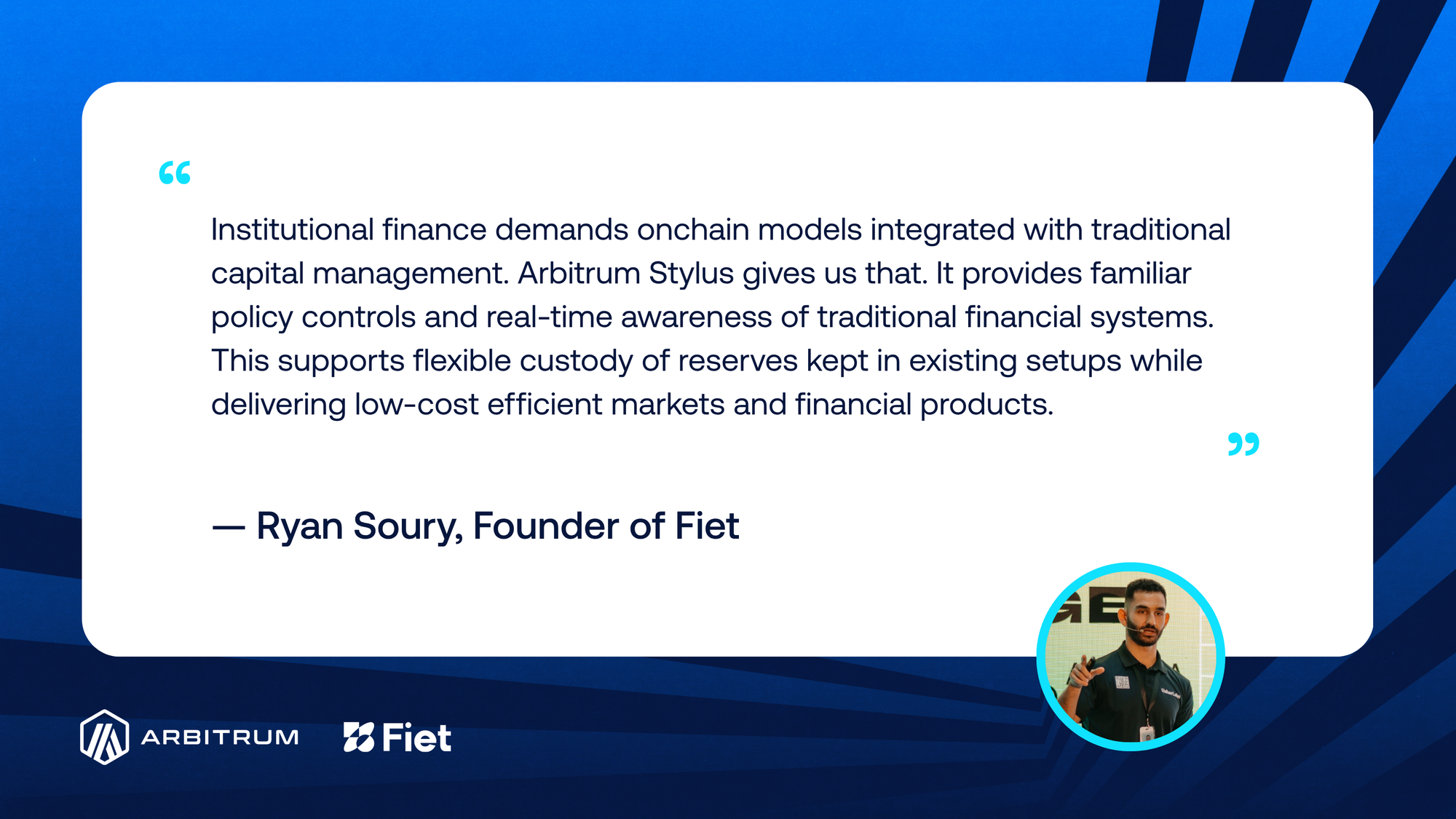
Stylus gives Fiet a lower-cost, more flexible control layer on Arbitrum. Fiet keeps reserves and heavy processing offchain, then uses Stylus for the policy layer that revalidates actions at execution time.
That matters because these workflows look more like institutional trading infrastructure than a DeFi smart contract. Stylus supports a broader WASM-based development model, making it a better fit for systems that need frequent reserve updates and low-latency data feeds. For Fiet, that means a more practical way to run reserve-backed liquidity onchain while keeping core treasury and custody systems offchain.
Fiet measured about 43% lower gas than Solidity for bounded iteration. In business terms, that means lower operating cost per policy check, more room for frequent updates, and a more scalable path for institutional market making onchain.
On Arbitrum, institutions have a practical way to bring reserve-backed liquidity onchain without moving all of their capital or rebuilding their entire stack.
What this improves for markets and users
The end user does not need to understand the underlying mechanics to benefit from them. The benefits are simple: deeper markets, lower slippage, and access to liquidity that would otherwise stay trapped in offchain systems.
This is especially important for tokenised funds and other RWAs. Many struggle to list on DEXs because there are few practical ways to seed an AMM pool, and the required liquidity usually has to be locked upfront. Fiet changes that. A token issuer can work with a preferred market maker, who commits verified reserves to support trading. That gives RWA issuers a more practical way to launch liquidity without having to fractionalise the asset just to get a market started.
That is the practical value of Fiet’s model. It gives institutions a way to support onchain markets with stronger controls and less capital inefficiency, while giving users better execution.
Disclaimer: The references and information regarding Fiet and its offerings are provided solely for informational purposes. This article is not, and should not be construed as, an endorsement or recommendation of such projects nor its offerings.