





L1 vs L2: Choosing The Right Chain Architecture For Your Enterprise


When enterprises decide to expand their business onchain, the conversation almost always starts the same way: “We want flexibility.” That instinct is correct; however, a common mistake is translating that sentiment into “We need our own Layer 1 (L1) blockchain.”
In practice, what most financial institutions require is flexibility over execution policy, user experience, settlement guarantees, revenue opportunities, transaction fees, transaction ordering, MEV, governance, risk and compliance posture, and reliable uptime. They most likely do not need (and in fact are typically disadvantaged by) ownership of consensus and validator economics. The distinction matters because owning consensus of an L1 means you are no longer just running a financial product; you are operating a blockchain infrastructure network, with all the cost, complexity, and operational risk that entails.
This article lays out some of the major trade-offs between deploying a Layer 1 (L1) vs a Layer 2 (L2) in order to help your business make an informed decision.
Cost
Pay for usage, not for what keeps the lights on.
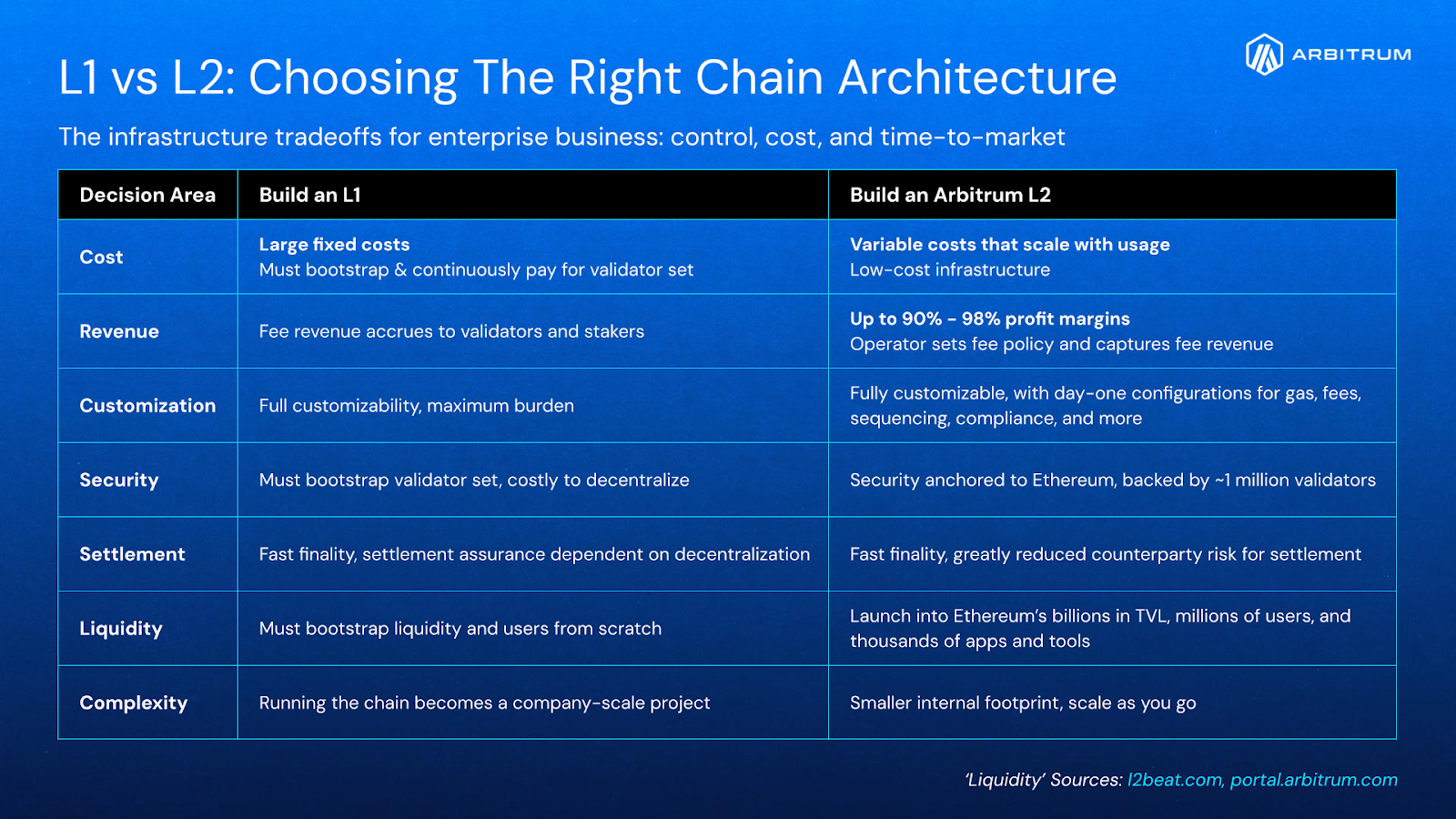
In order to achieve the counterparty assurance required for settlement and security (discussed later), an L1 should maintain a sufficiently decentralized validator set. As the chain operator, you will need to manage the incentives to attract and maintain those validators. That requires coordination of native token issuance, staking yield, inflation schedules, fiat-denominated subsidies, or some combination of these. That is a high-perpetual fixed cost that is independent of actual usage.
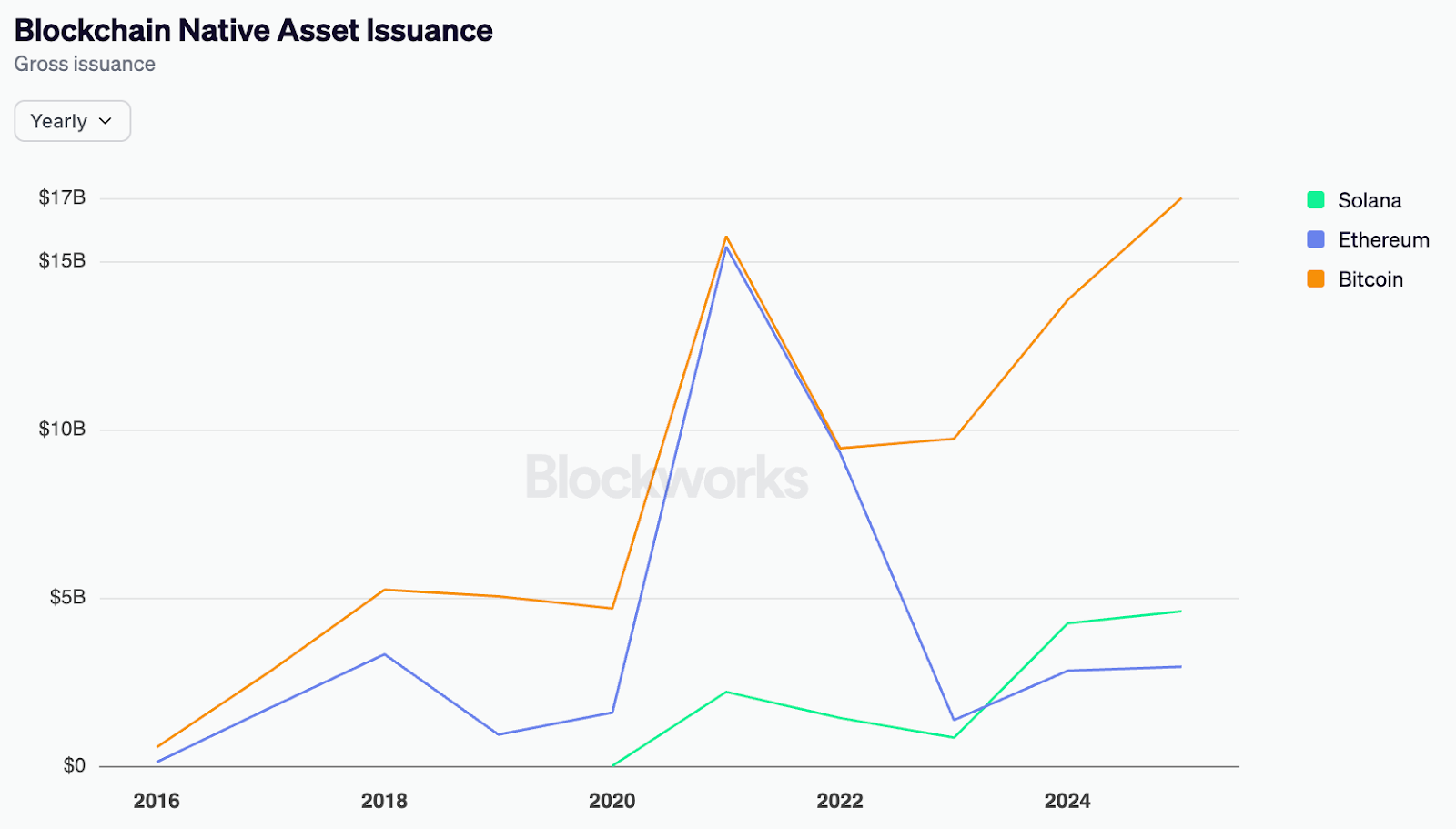
The chart below illustrates the fixed cost of securing an L1 network, represented by its annual token issuance. By late 2025, the annual security budgets (operator payments / issuance) across major L1s like Bitcoin, Solana, and Ethereum were measured in the billions of dollars.
By contrast, an L2 built with the Arbitrum Platform anchors settlement to Ethereum’s validator set of nearly 1 million validators and $78B in staked ETH used to secure the network. The security comes from the fees paid to Ethereum for data availability and settlement verification, a variable expense tied to actual usage. This allows you as the L2 chain operator to capture the fee revenue from transactions, instead of an external validator set.
Revenue
Capture revenue instead of giving it away.
L1s face prohibitively high operating costs, frequently leading to perpetual deficits. This often necessitates large fiat-denominated subsidies, or minting new tokens which in turn generates significant selling pressure. Any fee revenue generated by an L1 typically accrues to validators and stakers, rather than to the chain itself.
With an L2, your business has direct flexibility over three core economic parameters: the fee currency, the fee policy (including who receives fee revenue), and whether to monetize priority access during peak demand. Arbitrum L2s capture 90% to 98% operating margins because costs scale with usage rather than requiring perpetual validator subsidies. The commercial point is simple: you can price transactions at near-cost (or choose to sponsor them) while earning revenue from the applications built on your L2 platform.
Customization
Your chain, your rules.
A new L1 is an unbounded architecture scope, making your business responsible for building and/or maintaining the security model, upgrades, reliability, tooling, and the ongoing operations of the network. Additionally, core features must often be built and tailored to meet your L1’s design specs.
In contrast, the Arbitrum Platform gives you a wide set of day-one configuration options with minimal custom engineering, so you can meet common product requirements immediately. Beyond the defaults below, every component of the chain is fully customizable to your specifications as requirements evolve.
| Feature | Description |
|---|---|
| Throughput & Latency | Configurable throughput (up to 1 Gigagas/s) and block times as low as 100ms |
| Data Availability |
Rollup (full data on Ethereum, maximum censorship resistance) AnyTrust (Data Availability Committee signs off on data) External DA is also available through Celestia and EigenDA |
| Custom Gas Token | ETH or any ERC-20 token (governance token, stablecoin, etc.) |
| Sequencing | Custom ordering rules, including First-Come-First-Serve, Timeboost, or custom logic to manage MEV, enforce fairness, and comply with applicable regulations. |
| Execution Environment | EVM using Solidity plus Arbitrum Stylus, which enables more efficient smart contracts written in Rust, C/C++, Move, and AssemblyScript. |
| Compliance | Custom KYC / AML controls and transaction filtering capabilities to meet regulatory requirements. Easily integrate preferred compliance providers like TRM/Chainalysis to automate Sanctions and OFAC screening. |
| Permissions | Configurable permissions to control which users or groups can interact with the chain or specific smart contracts. Smart contract deployment can be open or restricted to approved developers. Built for enterprise and regulated environments. |
| Privacy | Configurable data privacy at the smart contract or protocol level, ranging from fully transparent to operator-level privacy based on your regulatory requirements. |
| Precompiles | Add chain-level native functions (e.g., protocol-enforced royalties, custom gas metering, application-specific logic baked into the chain). |
| Governance | Governance is configurable and may be fully self-governed, operated by a consortium, or in a permissionless configuration with clearly defined policies for membership, upgrades, and emergency controls. |
| Proving | Multi-prover support with settlement verified via Fraud Proofs, ZK Proofs and TEEs (soon), or combinations thereof. |
| And More... | Arbitrum Platform L2s are fully modifiable and customizable to your use case and business needs. The features listed above represent a subset of available configuration options. Learn more about customizing your Arbitrum L2 in the docs. |
Furthermore, building your L2 on the Arbitrum Platform greatly reduces your operational workload because it automatically includes virtually all new EVM and Arbitrum features and software upgrades developed by leading blockchain infrastructure teams.
Security & Finality
Finance applications need speed and certainty.
For enterprises, security represents counterparty exposure and settlement assurance: who you must trust for a transaction to be irreversible, what happens during an outage or dispute, and how cleanly the system explains “who wins” to risk, audit, and regulators. Separately, finality should be treated as a settlement assurance, not a speed claim: what is the ultimate settlement authority, and what is the timeline to reach a truly irreversible state?
On L1s, finality is defined by the chain’s operators and governance. If the L1 is centralized with few validators, the chain can make finality feel immediate, but every user, application, and service on top is taking direct counterparty risk in the chain operator. If the L1 is more decentralized, its ecosystem is better protected from unilateral operator action, but the operator trades away control over the chain's future: upgrades, protocol direction, and finality guarantees now depend on a distributed validator set that is still smaller and less secure than Ethereum L1. The operator now has counterparty risk on how the chain behaves under stress (reorgs, halts, emergency upgrades). In both cases, the final outcome is ultimately a property of that chain’s security and governance.
On an L2 built with the Arbitrum Platform, the model is simpler to underwrite because security and finality anchor to Ethereum with its validator set of nearly 1 million and $78 billion of staked ETH, rather than a newly bootstrapped validator economy. This approach allows operators to separate settlement into distinct layers:
- Soft Finality: transactions confirm in under a second, so users and systems can act immediately.
- Hard finality: transactions are committed to Ethereum L1 on a configurable cadence measured in minutes, providing an irreversible settlement guarantee backed by Ethereum's security.
- Withdrawals: the L2 state can be proven to Ethereum L1 in as little as 15 minutes using Arbitrum AnyTrust, or multi-prover for rollups, enabling users to withdraw natively to L1 without relying on third-party liquidity.
Additionally, because Arbitrum Platform L2s are built on Ethereum, you will continue benefiting from future Ethereum L1 upgrades. Namely, Single Slot Finality and Real Time Proving for L2s, which together can further reduce settlement of Arbitrum Platform L2s to seconds.
The benefit of L2s is clarity: a fast user experience, an externally legible settlement backstop, and a cleaner counterparty-risk story for internal stakeholders.
Liquidity and distribution
Launch into a thriving ecosystem.
If your product depends on stablecoin depth, tokenized assets, lending, or trading, liquidity and volume are often the most significant barrier to entry. A new L1 requires you to bootstrap that from zero. This could look like a long-term build-out of applications, wallets, exchanges, and bridging infrastructure with no guarantee of traction.
Launching an L2 with the Arbitrum Platform connects you to the Ethereum ecosystem and the deep liquidity that comes with it. Arbitrum One, the largest L2 on Ethereum, hosts over $16B in secured economic value, with millions of users and 1,000+ apps including lending, derivatives, and stablecoin markets operating at scale.
Operational complexity
Focus on your product, not the infrastructure
Running a standalone L1 becomes a permanent platform operation for core software upgrades, security monitoring and incident response, performance tuning, governance processes, and the ongoing work of keeping a distributed network healthy and supported, regardless of the amount of usage.
With an L2, you can keep the internal footprint much smaller. You use a proven stack and can rely on established infrastructure providers to run the “always-on” parts under operational discipline, while your team can focus on what institutions actually care about: product delivery, risk controls, compliance posture, and integrations with custody, payments, and treasury systems.
A phased path to market
Walk, then run.
Arbitrum allows enterprises to minimize market-entry risk through a phased 'launch-and-migrate' approach. This ensures your product can find traction and stable unit economics before transitioning to a dedicated chain. It looks like this:
- Launch your product first on Arbitrum One, a shared, liquid venue, where users, stablecoins, and integrations are immediately accessible.
- Validate your application in production: unit economics, control framework, risk/compliance, operations, and real demand.
- If your business later requires dedicated capacity and more flexibility over policy and economics, you can migrate to an Arbitrum Platform L2.
What makes migration with Arbitrum different is that this isn’t a “replatforming” event. Arbitrum One and dedicated Arbitrum L2s share the same underlying Arbitrum technology and core tooling, so the move from “app on Arbitrum One” to “your own Arbitrum L2” is a continuation of the same environment, rather than a full migration to a new architecture. In contrast, launching your app on an L1 first and later switching stacks typically means rebuilding integrations, reworking operational controls, retraining teams, and asking users and their liquidity to move with you, turning a proven product into a second launch.
Get started today
If you’re ready to bring your enterprise to blockchain, book a discovery call with our team to help get you started on the Arbitrum Platform.
Get In Touch: arbitrum.io/contact
Learn More: arbitrum.io/launch-chain