








How Rather Labs Built a Practical Path for Move on Arbitrum

Arbitrum Stylus expanded what teams can bring into the EVM. Instead of treating Solidity as the only path, teams can work in languages that fit their existing systems while still building inside one of the deepest financial ecosystems in crypto.
Rather Labs extended that model to Move in a way that goes beyond language support. They built a Move-to-WASM compiler, CLI tooling, and a framework for EVM interactions so Move contracts can run alongside existing EVM contracts on Arbitrum. The result is a more practical way to bring Move-based systems into a live financial environment without rebuilding core logic in Solidity first.
For teams building products with strict rules around assets, permissions, and state transitions, that changes the adoption curve. Accessing Arbitrum’s liquidity, DeFi infrastructure, and financial primitives no longer has to start with a full contract rewrite. It can start with preserving more of the system that already exists.
The problem with bringing Move to the EVM
For many teams, moving onchain is a product and infrastructure decision, not just a technical one. Arbitrum gives builders access to active liquidity, interoperable contracts, and mature financial rails. That makes it attractive for products that need to plug into real markets from day one rather than operate in isolation.
Move teams have faced a narrower path into that environment. Traditional EVM systems are centered on Solidity, while Move uses a different model for assets, permissions, and state. Expanding into Arbitrum often meant translating core logic into a new language and a new contract model at the same time.
That friction is especially costly for products where the contract defines the business rules. Asset issuance, settlement logic, and permissioned actions are easier to move onchain when teams can preserve more of the controls and assumptions already built into the system. Without that, the shift to Arbitrum becomes a larger rewrite project with more cost, more delay, and more execution risk.
How Rather Labs built a path to Arbitrum
Rather Labs turned that gap into a workable toolchain. Its compiler translates Move byteode into Stylus-compatible WASM, while the surrounding framework supports the functions needed to operate inside an EVM-compatible environment. The implementation includes storage mapping for Move’s object model, cross-contract calls, deterministic IDs, and utilities for common contract patterns.
This is what makes the project more than a compatibility layer. Move contracts can run as co-equal programs alongside Solidity ones, with interoperability in both directions and no changes required to existing tooling. Teams can bring Move-based logic into Arbitrum while staying connected to the liquidity, protocols, and contract infrastructure already present across the ecosystem.
For enterprises evaluating an onchain strategy, that lowers the threshold for experimentation and adoption. Existing engineering investment goes further. Internal teams can test products and workflows on Arbitrum without first committing to a broader platform reset, and they can do it in an environment that already supports meaningful financial activity.
Why Move and Arbitrum fit together
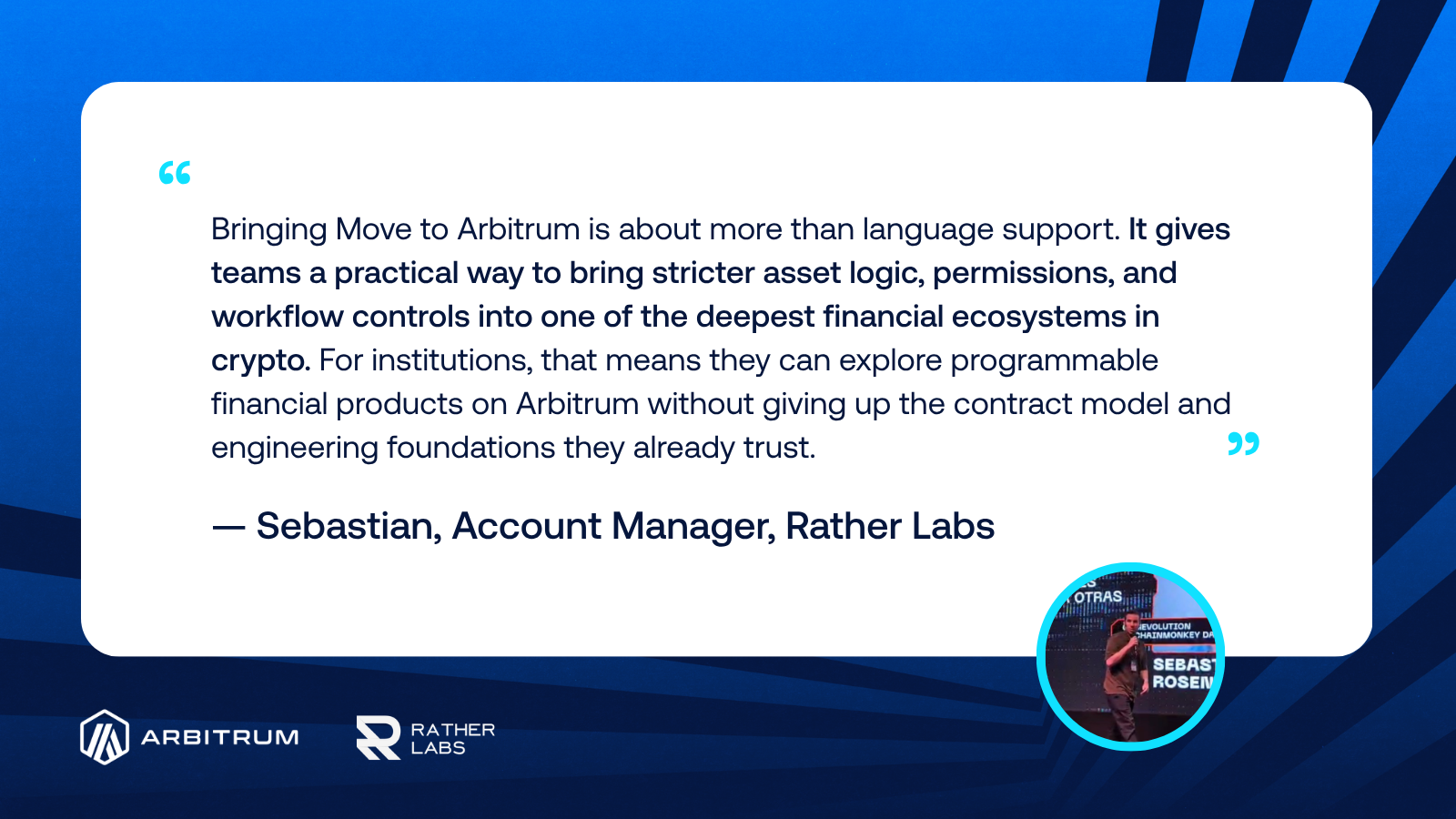
Stylus gives Arbitrum an EVM-compatible WASM execution layer. That opens the door for contracts written in languages beyond Solidity (such as Rust, C/C++, and AssemblyScript) while keeping them in the same execution environment. Rather Labs extends that model to Move.
Move brings a more structured way to express asset ownership, permissions, and state transitions in code. Rather Labs points to its ownership model, compile-time safety, and patterns such as capability and hot potato as part of that appeal. These features are useful in products where the contract is the source of truth for who can do what, when, and under which conditions.
That makes the combination especially relevant for financial products. A system that governs issuance, transfer rights, collateral flows, or settlement states benefits from having more of those rules encoded directly in the contract model itself. On Arbitrum, those semantics sit inside a market environment with active capital, established DeFi primitives, and interoperability across the broader EVM stack. Teams do not have to choose between Move’s contract model and access to the financial infrastructure already operating on Arbitrum.
What this means for enterprises and financial institutions
Markets, transactions, and business processes are increasingly defined in software. For enterprises and financial institutions, the value here is not simply that Move now runs on Arbitrum. It is that teams with structured asset logic and strict control requirements can bring more of that logic into a finance-native blockchain platform without starting over.
This shows up in practical ways:
- Tokenized assets may need tightly scoped mint and burn rights
- Collateral receipts may need to be consumed exactly once
- Settlement workflows may need explicit handoffs and clear permission boundaries
Move is well suited to these patterns because more of the intended rule set can be expressed directly in the contract model itself. Arbitrum gives those products a place to run with predictable execution, EVM interoperability, and direct access to one of the most developed onchain financial ecosystems.
Rather Labs expands who can build on Arbitrum and what kinds of systems they can bring with them. The immediate benefit is a more practical path for Move-based development. The broader impact is that Arbitrum becomes a more realistic platform for institutions and financial builders that want to move asset logic, workflow controls, and business rules onchain without absorbing the cost of a full Solidity rewrite.
Talk to our team to bring your Move project onto Arbitrum.